
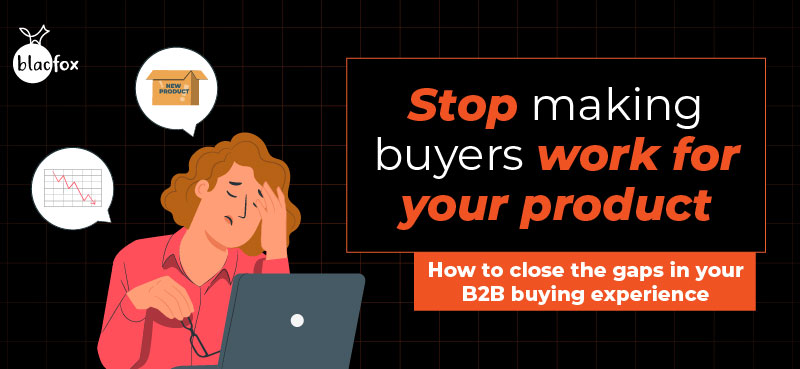
How to close the gaps in your B2B buying experience
Buyers today expect to find all the information they need to make a purchase decision before they ever speak to someone. Consumer technology has trained them to expect self-service, and that expectation doesn’t switch off when they sit at a work laptop.
Yet most B2B vendors are only providing a product description and a link to book a meeting.
Most vendors know this is a problem, but few have fixed it. And the reason, until recently, was legitimate.

B2B buying isn’t simple. A single order can involve custom pricing negotiated months in advance, approval chains that span three departments, and contract terms that no standard checkout flow was ever built to handle.
So, the sales rep sitting in the middle of that process wasn’t just there because buyers wanted them. They were there because the transaction needed someone to hold it together.
That defence is running out. AI agents are now handling the parts of the buying process that made human involvement feel necessary. They can surface the right product configuration based on a buyer’s account history, apply negotiated contract pricing in real time, generate an accurate quote without a rep pulling data from multiple systems, and route the order through the appropriate approval workflow before a human ever needs to get involved. The complexity is still there but the human bottleneck in the middle is no longer necessary for routine purchases.
This matters because according to Gartner, by 2028, AI agents are projected to intermediate more than $15 trillion in B2B purchases. The vendors building the infrastructure for that now will absorb the deals. The ones waiting will spend that time wondering why their pipeline has thinned.

The vendors winning right now are building both digital and rep-led sales. Digital-first for buyers who prefer researching, evaluating, and forming opinions without anyone’s help. Human expertise for buyers who prefer it and for late stages, where stakeholder alignment, contract negotiation, and implementation planning require judgment that no agent can replicate.
According to Gartner, organisations offering both rep-led and self-service interactions are 3.9 times more likely to exceed profit growth expectations than those running one model or the other.

The practical question is where the friction lives in your current buying experience and what you can do about it today. These are the three areas to look at.
1. Quote generation
Here’s how B2B quoting usually works: the buyer emails or fills out a form. A rep digs through several systems to pull the numbers. Days later, a PDF shows up, and the buyer’s left to make sense of it alone. By the time it lands, the momentum is already gone.
AI-powered quoting tools can sit on top of your existing pricing logic and product catalogue. When a buyer submits a request through your website or portal, the tool matches it against your pre-configured pricing rules. It then builds the quote and sends it back without a rep touching it. The rep only gets involved when the deal is complex enough to need them.
2. Demo and product access
Buyers want to see your product before they commit, and a demo is the best way to show them. But according to TrustRadius, 40% of B2B buyers say having to go through a sales rep just to access one makes them less likely to buy.
Interactive sales demo tools let you build self-guided product tours that buyers can access directly from your website without a rep involved. A buyer clicks a button on your site, walks through your product at their own pace, and arrives at a sales conversation already convinced rather than still evaluating. The setup involves recording your product flow once and publishing it as a clickable experience. Most teams have a live tour within a week.
3. Onboarding and post-sale access
The buying experience doesn’t end at the signed contract. If your buyers have to go through a rep for routine requests after the deal is done, you risk losing the confidence that made them choose you. Lose that, and you lose the renewal and the referral too.
AI agents can be trained on your product documentation, your order data, and your onboarding process and then left to manage post-sale interactions independently. An agent can identify that a customer is three weeks into onboarding, notice they have not completed a key setup step, and reach out with the right guidance before the customer realises they are stuck. A human only enters the conversation when the situation genuinely requires one.

Adopting AI across your entire buying experience at once is not a realistic starting point for most businesses. But doing nothing is how your competitors get ahead of you.
The better approach is to sit down with your sales team and map out where buyers are dropping off, slowing down, or asking for things you cannot give them quickly.
That conversation will surface your biggest point of friction faster than any audit will. Once you know where the problem is, you can start building towards an AI solution, whether that is faster quoting, easier demo access, or better post-sale support.